
There is a quiet menace creeping through the endless, procedurally generated landscapes of survival crafting games. It is not a new boss, nor a resource drought, nor even a griefing player. It is the Cube—a four-walled, flat-roofed, utterly soulless shelter that pops up wherever ambition meets laziness. By 2026, after years of watching this architectural virus spread across Arrakis, through Viking purgatory, and into underground research facilities, the time has come to confront the question: why do so many adventurers pour dozens of hours into gathering resources, only to assemble them into a featureless box that would make a Soviet-era planner blush?

The Cube phenomenon is immediately recognizable to anyone who has ever joined a multiplayer server with friends. It is the game equivalent of a beige office cubicle dropped into a Tolkien painting. Walls rise at rigid 90-degree angles, a single door punctuates one face, and a perfectly flat roof caps the structure like a lid. Sometimes there is a floor made of actual building pieces; just as often, the bare dirt serves as ground. The entire construct screams urgency—a rush toward functionality that leaves beauty dead in a ditch. Unfortunately, it also screams male living space, that internet-famous aesthetic of a mattress on the floor and a TV perched on a milk crate, now haunting digital worlds.
Who is responsible for these crimes? Usually it is the friend who wants to jump straight into exploration and mass production. Their mind buzzes with thoughts of ore deposits, tech trees, and boss fights, while the very idea of a decorative eave or a staggered wall sounds like a waste of precious minutes. Meanwhile, the more aesthetically inclined player transforms into the fantasy equivalent of a retired neighbor with too much time and a copy of the HOA rulebook. They wander the settlement, tutting at the sight of yet another gray rectangle, wondering aloud if that paint color—or utter lack of it—has been approved by any sane community.
The raw offense of the Cube is not just about looks; it is about the vandalism of potential. Every survival game offers players a canvas. Even the harshest biomes, like the ashlands or deep desert starting zones, are framed by stunning vistas, dynamic lighting, and carefully crafted ambiance. When someone slaps down a PS4-shaped monstrosity amid those vistas, the contrast is jarring. It turns a fantasy landscape into a government office park, draining wonder from the world one symmetrical wall at a time.
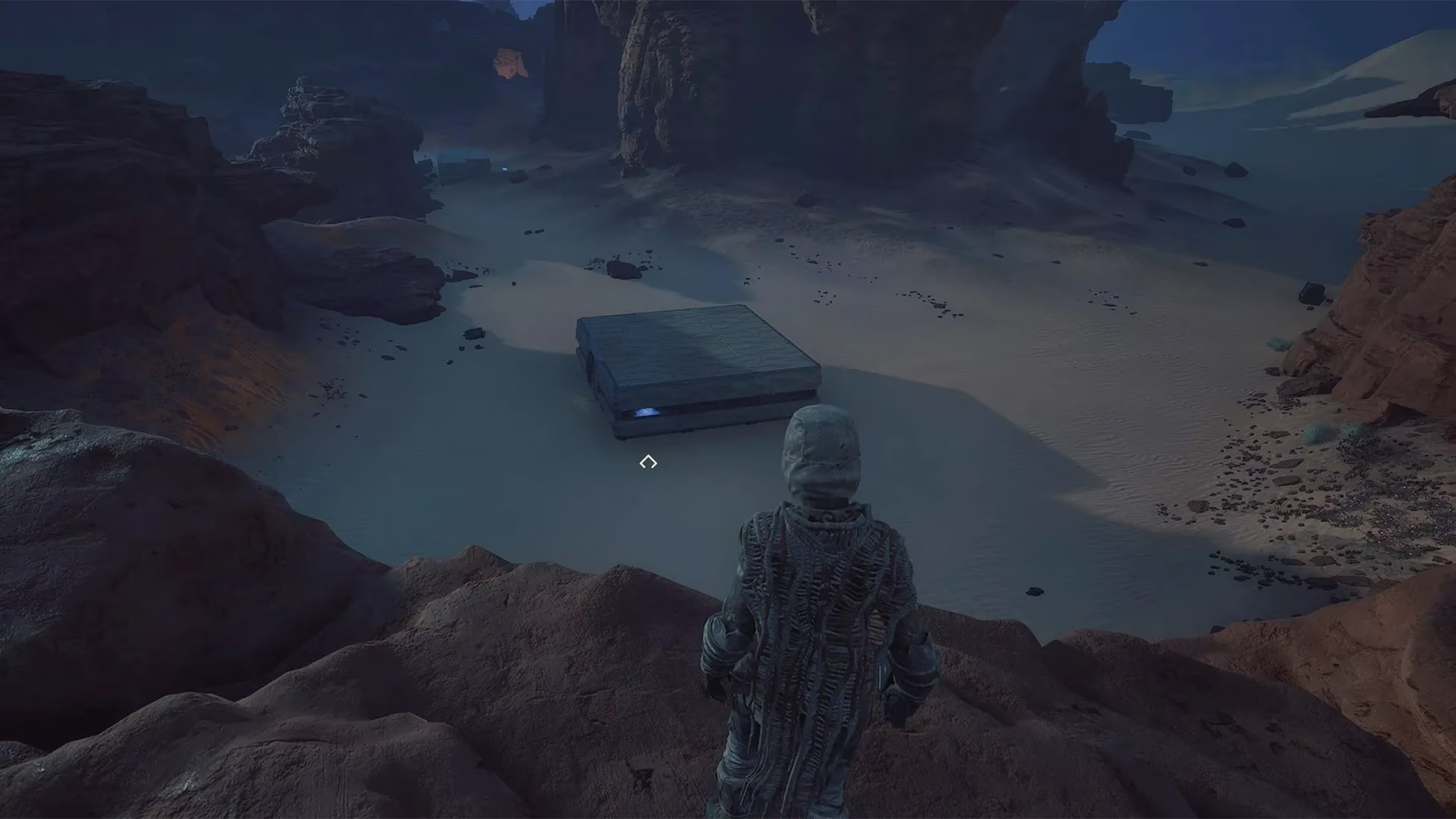
Take Dune: Awakening, for example. The brutalist aesthetic of Arrakis might seem to forgive a little boxiness, but the game’s starting zones are littered with buildings that look as if they were churned out by a malfunctioning printer. They share the exact dimensions, the same lifeless gray texture, and the same absence of any architectural soul. Truly, is there a rock shortage on this planet? Players stand surrounded by free resources—sandstone, cliffs, wreckage—yet their answer to shelter is always a carapace that could double as a shipping container. Even the earliest tools in Dune: Awakening offer more than one shape. A corner could be deleted, a second floor added, a small terrace carved out. Instead, the Cube remains, an act of defiant minimalism against the spice-laden winds.
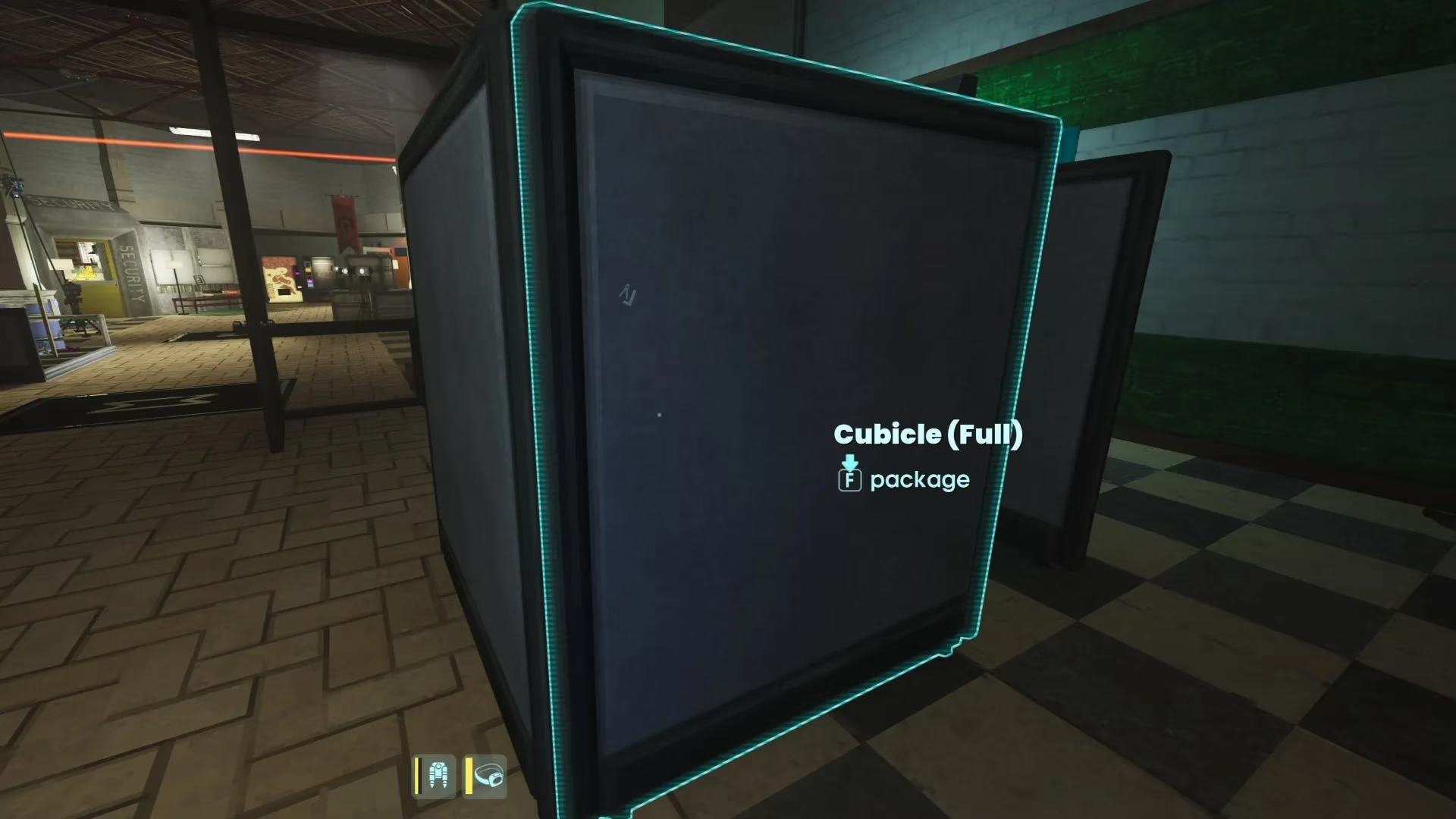
If desert boxes are bad, the cubicles of Abiotic Factor present a different horror. Here, players do not build entire structures from scratch; they set up camp inside pre-existing rooms in a vast research facility. Yet the impulse toward oppressive symmetry follows them indoors. Workstations line up with militaristic precision, storage crates form perfect grids, and cables snake across the floor in a Gordian knot of negligence. The result is not a cozy lab but a fire hazard that would make an OSHA inspector weep. One might ask: if we are roleplaying as scientists, should not some degree of order—and basic cable management—be expected? Turning off the grid snap and rotating a bench to a 45-degree angle is not radical; it is the bare minimum of personality. But no, the Cube is a state of mind, and it infects even laboratory bays.
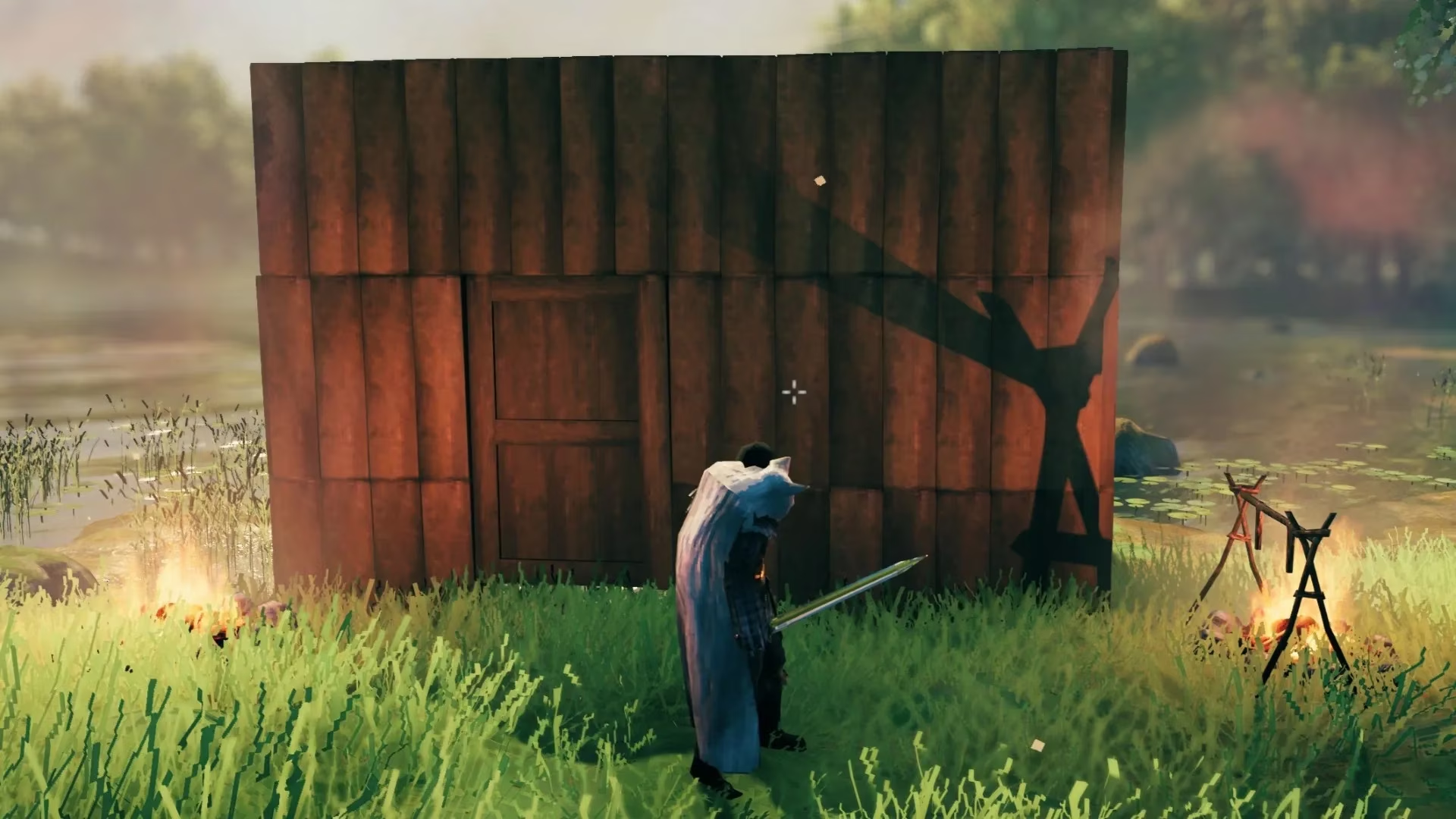
Valheim deserves a special mention in this catalog of tragedies, because its Viking afterlife is simply too gorgeous to deserve such treatment. Even the most barren biome—the Mistlands, the Plains, the freezing peaks—offers a backdrop of swaying trees, god rays, and atmospheric fog that begs for a longhouse, a stave church, or at the very least a charmingly rustic cabin. Yet among the beehives and boar pens, the Cube rises like a tombstone. Flat ceilings instead of pitched roofs, no decorations, not even a sign to label a chest filled with greydwarf eyes. Raiders might come, and the secret prayer of the neighborhood architect is that trolls will smash the box first, sparing the whimsical villa next door from collateral damage. It is mean-spirited, perhaps, but how can one focus on their own elegant inglenook when a giant square dominates the view?
The psychological roots of Cube addiction are understandable. At the start of a new world, the brain fixates on efficiency. Night is falling. A workbench needs shelter. Resources are scarce. Under pressure, the simplest enclosure provides the fastest protection. The tragedy is when that temporary expedient fossilizes into a permanent base, expanding only outward in an ever-growing grid, while its builder dreams only of the next sword upgrade. Is it really so much harder to add a gable, a window, or an asymmetrical wing? These small gestures cost almost nothing but utterly transform how a settlement feels to inhabit.
By 2026, the tools for beautiful building have never been more accessible. Mods like Valheim Plus remove structural limitations, Dune: Awakening has continuously refined its construction system, and games like Enshrouded and Nightingale launch with extensive decorative options from day one. The cold truth is that the Cube is no longer a result of limited resources; it is a choice—a choice to ignore the artistry of the world in favor of a spreadsheet mentality. And the community notices. On public servers, architectural eyesores become landmarks of shame, whispered about in Discord channels. Newcomers circle them, wondering if they missed a tutorial on ramp building.
What would happen if every player took a five-minute pause after erecting their box shell? They might delete a corner to break the tyranny of the rectangle. They might slap a slanted roof on top and instantly add a dimension of homeliness. A balcony, a chimney, a flower planter—these are not frivolities, they are the acts that turn a base into a home. They invite other players to linger, to socialize, to co-create a world that feels alive rather than one that resembles a warehouse district.
Of course, there will always be those who defend their right to build a giant pigeon coop, citing “it is just a game” or “I’m only here for combat.” Fair enough—but if we are sharing a server, the visual realm is communal. One player’s functional box is another’s broken immersion. Perhaps the solution is not demolition but friendly remodeling under cover of night. A neighborly soul might log in while the Cube’s owner sleeps, delete a wall here, add a slanted roof there, plant a few raspberry bushes, and leave a sign that reads: “A nice Dutch gable really brings the whole house together, you know?” The next morning, when the efficiency-focused builder logs in, what they find is not a violation—it is an invitation. An invitation to see that building can be as much a part of the adventure as anything they loot from a crypt.
After all, in a world where we can slay dragons, sail across procedurally generated seas, and mine asteroids, surely we can muster the creativity to produce a structure with more than six identical faces. The Cube has had its reign. It is time to let it crumble.