
I still remember the exact moment a sandworm ate me in Dune: Awakening. One second I was jogging across Hagga Basin, clutching my last drops of moisture and feeling like the king of Arrakis. The next, the sand opened up like a hungry mouth, and a giant phallic cretin sucked me down into the bowels of the planet. If you think being chased by a sandworm is bad, try being eaten by one. It does not just kill you. It eats everything you are carrying: clothes, weapons, and especially your Spice Liquor. Suddenly I respawned at my base in nothing but my underwear, forced into the run of shame across the sands to rebuild my inventory. 🪱
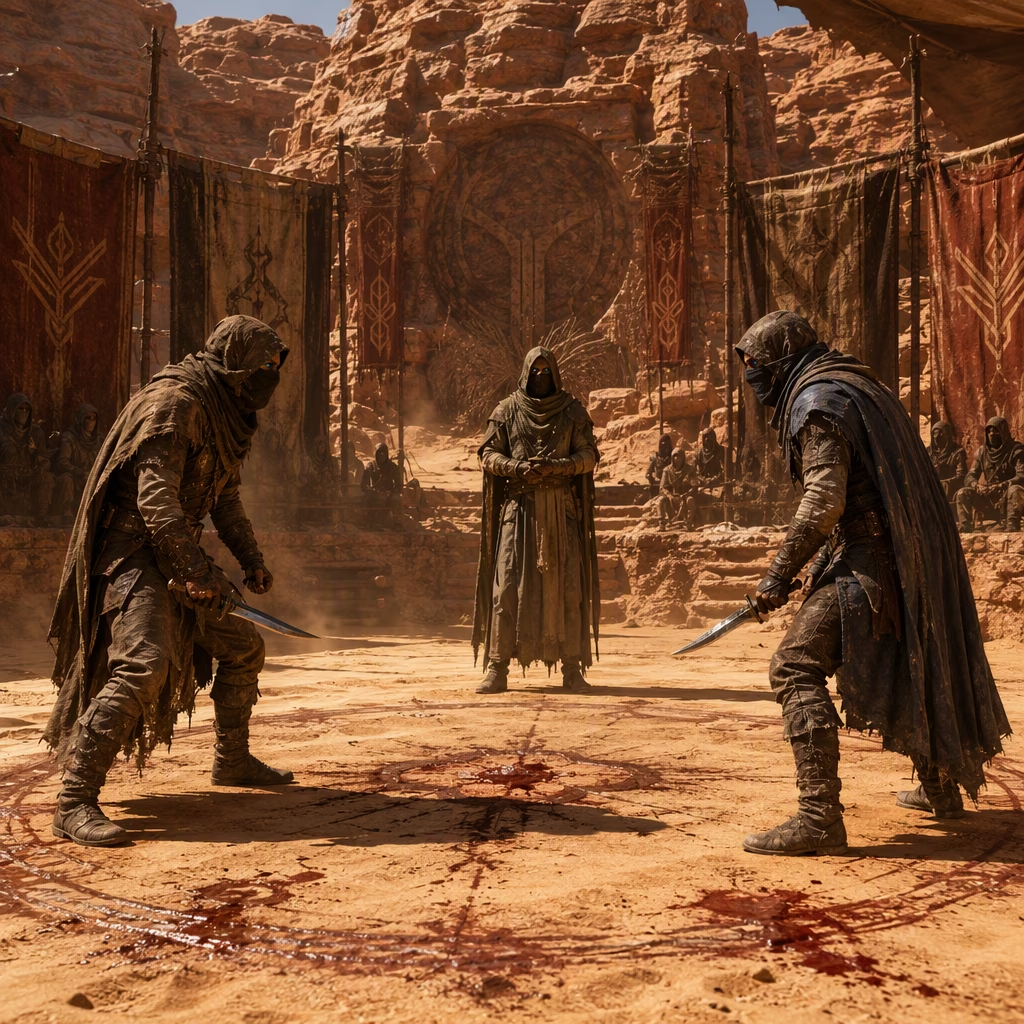
It is easy to be skeptical about an MMO survival game set in the Duniverse. I was. But after a few bouts of dehydration and sunstroke, the day I spent in Arrakis convinced me that Dune: Awakening is one to watch. More than that, if Funcom can deliver on its endgame plans, it could see an EVE Online-style future for its hardcore playerbase. This massive project comes from Funcom, the studio famous for Conan: Exiles and its dong slider. It sets you on a path from broke-ass Arrakis hobo to influential figure harvesting Spice on an industrial scale and pushing a personal agenda at the Landsraad. It has everything you expect from an MMO: intricate skill trees, PvP mechanics, base building, character customization. Plus ornithopters and mind-altering substances. What is not to like?
Dune: Awakening takes place in an alternate timeline where Lady Jessica had a Sliding Doors moment. She followed the Bene Gesserit instructions and had a daughter, Ariste, instead of the little twink we know and love, Paul Atreides. Cut to 29 years later. The Harkonnens and Atreides are at war over Arrakis. The Fremen have apparently been wiped out. Alternative religions have evolved to fill the gap left by Lisan al-Gaib. The alternate timeline is not meant as a nipple twist to fans. Funcom needed narrative space to make the player character consequential. Producer Nils Ryborg explained: 'Obviously we did the somewhat controversial but I think very correct choice of creating the alternate history, which allowed us to detach a bit from what was going on in the movies and kind of focus on developing the game.' It also lets Funcom bring big-name characters back into the story. In the books, many die early. Here, they stick around. There are things fans want more of, like sandworm riding. That will not be at launch. But Funcom will look at it in the future. If that still does not sit right, Dune purists should know Funcom got the blessing of the Herbert estate. They worked with it and the current movie makers to keep everything true to the lore. It influences skills, crafting progression, and the whole identity of the game.
I have played a lot of survival games. Drop me naked in a jungle and I will happily bash rocks and branches together for hours. Abandon me penniless in a fantasy landscape and I will be crafting swords before breakfast. Dune: Awakening stands out the minute you exit character creation for one very stressful reason: Arrakis is not a tropical island or a verdant forested ecosystem. In the opening area, Hagga Basin, there is no water, scarce wildlife, and a distinct lack of coconuts. Oh, and the sun is really, really hot. You are susceptible to sunstroke. Scavengers want to kill you everywhere. And did I mention the sandworms? For the first few hours my entire life hinged on dew drops, granite, and plant fibers. An NPC with a pet bat babied me through the basics of weapons, armor, and hydration until I could make it on my own.
You are not totally pathetic during this time. You unlock abilities as you gain experience. I leaned into my manipulative wifey side and chose Bene Gesserit skills. That gave me the power to compel enemies towards me and hang in front of me for a few moments before they went back to trying to kill me. Do not get me wrong. I was still very much a toddler in the eyes of Dune: Awakening. One ability I unlocked was better sunstroke tolerance. But by the end of the day I had slightly better weapons and had mastered a super fast dash move that got me out of trouble. I could only dream of the wild combinations of ranged and melee combat, combined with passive and active abilities that can be swapped in and out according to need. The developers showed those off. Skill point acquisition felt fast enough that I will get there without too much hanging around once I am playing at home. You will not be tied to your first specialty either, so you can mix and match.
| Starting class | What it does |
|---|---|
| Bene Gesserit | Manipulation, compulsion, and creepy mind tricks |
| Trooper | Straightforward combat and guns |
| Mentat | Recon and strategy |
| Swordmaster | Blade-focused melee mayhem |
Another key element I only got a taste of was Spice, the very lifeblood of Dune lore. Spice is powerful in Dune: Awakening in every sense of the word. It is also not easy to amass as a lone noob in the early hours. You will find Spice Liquor and food in the world which unlocks a brief period of Prescient power, though it comes with withdrawal symptoms. Later in the game you can build transports, harvesters, and automated Spice-collection systems to score the quantities you need for trade, serious crafting, or managing a raging Spice addiction. I suspect the value of Spice to players, versus the pain of collecting it, will be something Funcom balances long after release. Ryborg said: 'I think Spice is really cool. Obviously super important in the lore and we use it not only to... it has some story aspects that I won't get into, but it's also the fact that we can use it to improve the strength of our abilities and how well we get to interact with them. But then having the drawback of Spice addiction and needing more of it, and it's like constant need of more and more and more. A lot of the endgame systems being reliant on, Hey, can you get enough Spice to pay all your taxes for your huge base and to have the correct political sway that you need and build whatever endgame things that you need to build? I feel that's been a very rewarding thing to pull off because we're now allowing all the iconic things that you think of from the Dune books to become natural mechanics that fit very well into the game. If you're constantly high up on Spice, you will start seeing weird and wonky things. I think it's fun, right? Because you're empowering your abilities, but you're also potentially putting yourself in a situation where you have worse possibilities. So you're balancing that whole act of, Oh, I need to do this or this. And then also knowing that you need this resource for progression in other mechanics. So you're tapping into it now for a temporary boost for this fight but long-term I need this to pay taxes, gain political sway, and so on.'
Once you have learned to live Arrakis style, you can focus on more than just beverages. There is a simple building system so you can construct your base, or sub-fief. You slowly fill it with machines that automate the basics of survival. One machine extracts water from blood harvested from enemy corpses. Another purifies the ores you find. You need a fabricator to create armor and weapons. We only had access to very basic granite building blocks at the early stage, but customization options increase as you progress. Personally, I cannot wait to build some severe mansion with Harkonnen aesthetics. You can also copy your base to move as your focus turns to new areas of Arrakis. That means none of the tedious multiple-base nonsense that survival players are sometimes cursed with.
It is easy to picture my time spent in a loop of harvesting materials, completing side quests or contracts, and taking out Scavengers whenever I come across them. And I came across them a lot. Camps are dotted around the map, and enemies respawn there regularly, so you always have some walking blood bags to exsanguinate when you need to. At times the enemies and camps felt a little cut-and-paste. Early on I passed the same camps over and over as I ran across the map, staying in the shadows to avoid the heat of the sun. Dealing with them started to feel like a grind. Close to the end of the demo, the development team took pity on us and spawned ornithopters. It is easy to see how that issue will not reappear once you are not trudging back and forth across the map looking for a new supply of ore.
You are free to wander the desert collecting twigs, but there are multiple story arcs, or Journeys, that push you deeper into the world. As well as bat boy's Arrakis 101 seminar, there is a Herbertian set of trials you are tasked with completing after a Spice Dream. That is where things get trippy. No spoilers, but the first, the Trial of Aql, involves stealthing around a cavern to avoid the notice of a giant golden glowing eye. The weirdness was a welcome interlude in the cycle of harvesting materials, killing scavengers, and fulfilling basic contracts for the tradepost. I am hungry to know what the other trials have in store.
Some stuff I did not get to try was the more social side of Dune: Awakening. Prove your skills for survival and skulduggery in Arrakis and you get to the endgame, wielding influence at the Landsraad. There, factions of players can make choices that affect the world. Since I was in the toddler end of the pool, I only experienced the PvE part. With everything else I was trying to deal with, that felt like a blessing. Ryborg says that while you can enjoy the game as a loner, those later social aspects will be vital to being an Arrakis Kingpin. That includes taking on tough dungeon-style lab locations and trading for items. He said: 'So we've got the whole story and there's a lot of single player content but there are areas where you definitely need other people. If you want to get into the really tough ecological testing stations, some of the tougher ones, you definitely need people. But especially when you want to delve into the deep desert, the full endgame. If you want to engage in the endgame political loop, you will need more people. If you want to do the proper big Spice raids and actually get enough resources to really make a dent into the endgame, you will need people. But I think one way to think about it is you don't have to do that every second of the day. That can be like, let's plan a big event as a group of people, let's go do that. And then the rest of the time you can enjoy building your base and engaging with the story and building up your character in different ways.'
It might not be easy, living in the world of Dune: Awakening, but as a Frank Herbert fan I am confident the experience is in good hands. It is a combination of solid mechanics that put a twist on the usual scenarios and a deep, deep obsession with Herbert's work that strengthens the world building beyond most narrative designs. Yes, I am basically peeing in my Stillsuit with excitement, even after all the sandworm trauma. Now I just need Funcom to add an ability to make a Muad'Dib my in-game pet, rather than just another furry blood bag. And if you are jumping into Arrakis in 2026, remember: watch your water, watch your Spice, and for the love of Shai-Hulud, watch your underwear. 🏜️💧🌶️
The following breakdown is informed by Newzoo, whose market-level reporting helps contextualize why a high-friction survival MMO like Dune: Awakening can still thrive: harsh onboarding loops (water scarcity, heat management, and punishing sandworm loss) often act as a self-selecting filter that strengthens long-term retention among dedicated players, especially when the endgame expands into guild-scale logistics, territory influence, and politically driven goals that keep groups organizing beyond basic crafting.