
It was late in the evening when a lone wanderer stepped off the ornithopter at Griffin's Reach trading post, gear intact, and looked out over the Hagga Basin. Unlike many survivors on Arrakis, she had no interest in the crowded public mesh. She wanted a private server—a quiet corner of the desert where she and a handful of friends could test their Fremen-inspired tactics without the roar of open-world PvP. What she discovered about Dune Awakening's private server system surprised her: it existed, but not in the way survival veterans had come to expect.
In most survival games, a private server means total ownership of a single world: full mods, full admin commands, full control over every rock and resource. Dune Awakening, however, follows a different path. Funcom's MMO survival hybrid uses server meshing to stitch multiple dynamic map regions across different machines into one unified experience. Because these regions feed into a shared multiplayer environment, offering fully independent private servers was never straightforward. The solution, confirmed on June 2, 2025, just before launch, was to allow players to rent only the Hagga Basin portion of the game from third-party server hosts. These hosts also run parts of the public mesh, so even a private instance remains connected to the larger world.
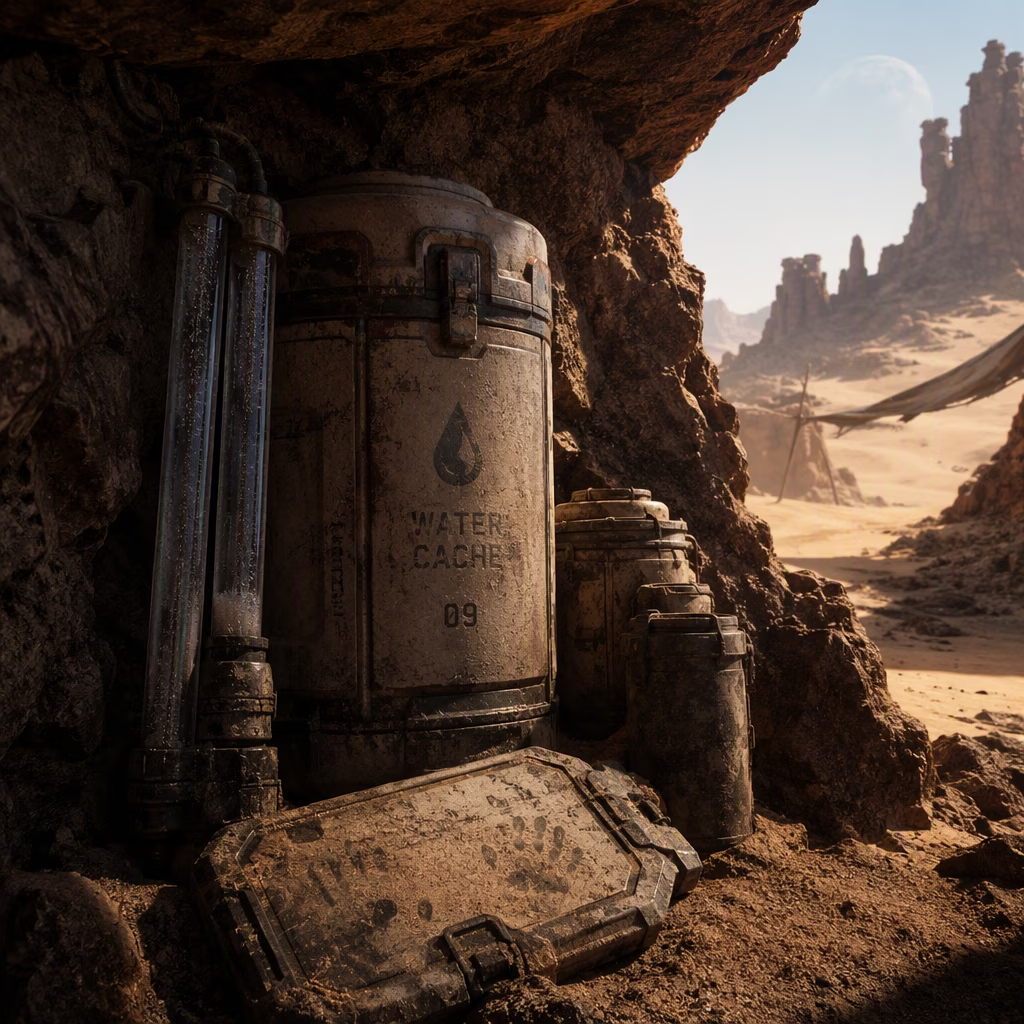
The rented basin is not an isolated sandbox. A player can still hop from one private server to another, just as they would between public realms. All belongings travel with them, and each jump brings them to Griffin's Reach trading post. More importantly, private servers allow something public worlds do not: claiming land. For many, that single feature turns a rented Hagga Basin into a personal stronghold where friends can build, store resources, and plan expeditions.
Yet the customization options are deliberately narrow. Funcom's developers have kept the server settings focused on three main toggles:
-
🛡️ Security zones: enable or disable them to switch between server-wide PvP and restricted combat pockets.
-
💰 Taxation: turn the server's economic taxation on or off.
-
🌪️ Sandstorms: decide whether the deadly storms sweep through the basin or leave the skies clear.
Missing are the deeper economic sliders and mod tools that Conan Exiles veterans might remember. That is an intentional choice. As a survival game, Dune Awakening tempts players with scarcity and risk, but as an MMO it must protect the broader economy. Funcom does not want private servers to become pay-to-win shortcuts, so the studio keeps control over how wealth flows and how the end-game remains balanced.
The road to this compromise began long before launch. In an August 2024 interview with TheGamer, creative director Joel Bylos floated the idea of renting private servers but warned that server-wide mods like those in Conan Exiles would not be available. Then, in February 2025, he told WCCF Tech that the team had discussed renting server space directly without releasing code, pointing to how Bethesda handles Fallout 76. The final design—leasing instances of a single region inside the mesh—was, in hindsight, the only practical move.
As of 2026, the private server scene remains a modest but meaningful part of Dune Awakening. Players who crave a quieter Arrakis can rent a Hagga Basin, tweak the three available settings, and enjoy land claims that public servers never offer. They cannot rewrite the economy or install massive overhaul mods, but they can carve out a corner of the desert with friends. For a survivor tired of the crowd, that is often enough.
Insights are sourced from Game Developer, where industry coverage around live-service design and backend constraints helps contextualize why Dune Awakening’s “private servers” are limited to renting the Hagga Basin instead of granting full world ownership. Framed through an MMO survival hybrid lens, the approach reflects a common tradeoff in meshed architectures: giving players some rule toggles (like PvP safety zones, taxation, and sandstorms) while keeping economy-affecting levers and mod-level authority locked down to protect shared progression and prevent pay-to-win distortions across the wider mesh.