
As a seasoned explorer of the unforgiving sands of Arrakis, I've learned that survival often depends on more than just skill and strategy; sometimes, it hinges on a single, bold discovery. In the vast, multiplayer deserts of Dune: Awakening, launched back in June 2025, we've all faced the daunting challenge of navigating treacherous cliffs and deep ravines to get our precious cargo home. The risk of losing everything to a misstep is ever-present. But recently, a fellow player named firepixel shared a revelation that turned our understanding of the game's physics on its head, and it all revolves around a simple buggy and a complete disregard for gravity.
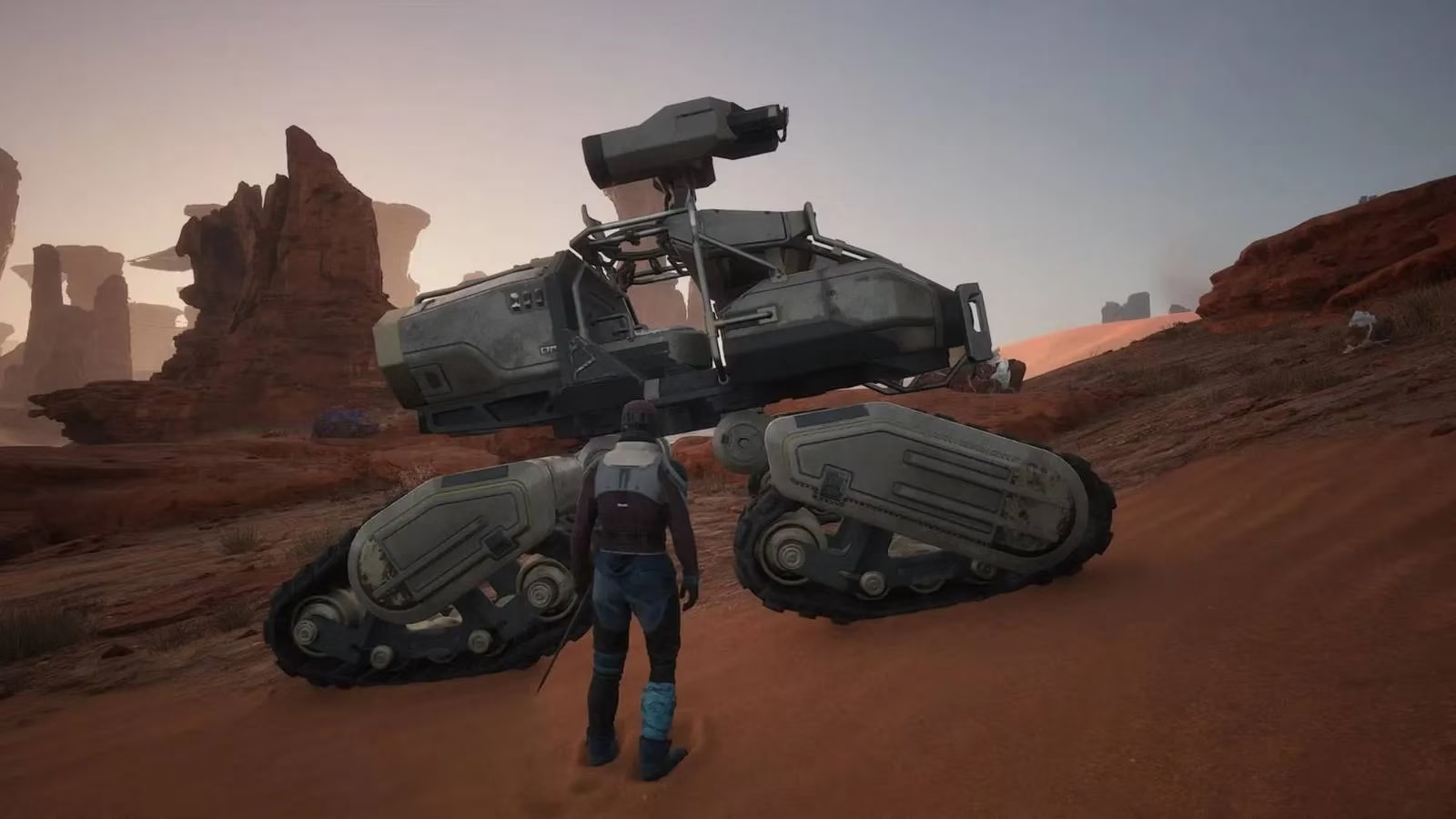
I remember the first time I saw the clip on the game's subreddit. My heart nearly stopped. There was firepixel, buggy loaded to the brim with shimmering aluminum, perched on the edge of a cliff so high it made my palms sweat. Without a second thought, they just… drove off. The vehicle plummeted, a tiny speck against the canyon wall, free-falling for what felt like an eternity. We all braced for the catastrophic explosion, the lost resources, the inevitable respawn screen. But it never came. The buggy landed with a soft thud, wheels intact, right at the entrance to their base. Safe. Sound. It was, in a word, glorious. This wasn't luck; it was a calculated exploit of a fundamental game rule: vehicles in Dune: Awakening do not take fall damage. 🚗💨
The community's reaction was a mix of awe, laughter, and immediate strategic recalculation. We'd been painstakingly charting winding paths down these cliffs, exposing ourselves to worm sign and enemy players, all while the fastest route was a straight line down. As one player put it, "We've been playing checkers while firepixel is playing 4D chess." This trick highlighted a mechanic many of us were too afraid to test. The fear of losing hard-earned spice or aluminum to a foolish jump had kept us on the conventional paths. Now, a new paradigm emerged.
The Vehicle Advantage:
This physics-defying property isn't limited to just the buggy. Through collective testing, we've confirmed it extends to other ground vehicles:
-
Sandbikes 🏍️: Agile and fast, now capable of becoming impromptu flying machines.
-
Sandcrawlers 🚛: The heavy haulers can now make deliveries via airborne express.
The contrast with being on foot is stark and, frankly, a bit painful. As a lone explorer, I've taken plenty of "non-lethal" fall damage, hobbling away from a short drop with a bruised ego and a depleted health bar. Knowing I could have simply summoned a vehicle to negate that entirely changes how I view every cliff face on Arrakis.
However, this discovery has sparked a fierce debate within the community about game balance and design intent. Is this a clever use of mechanics, or does it break the core challenge of Dune: Awakening?
The Great Debate: Keep It or Patch It?
| Argument For Keeping the Trick | Argument For Patching It Out |
|---|---|
| 🤔 It rewards player ingenuity and discovery. | 🛠️ It trivializes the intentionally difficult terrain, a key survival element. |
| ⏱️ It's a huge quality-of-life improvement for solo players hauling resources. | 🏰 It undermines base defense; why build a cliffside fortress if enemies can just drive down? |
| ⚔️ Could be balanced by applying fall damage only in PvP zones, preserving its PvE utility. | 🗺️ It bypasses the need to explore and learn the map's intricate pathways. |
| 😄 It's just plain fun and creates memorable, cinematic moments. | ⚖️ It creates an unfair advantage for players who know the exploit over those who don't. |
I find myself torn. On one hand, the sheer convenience is intoxicating. That aluminum run that used to take 15 minutes of white-knuckle driving now takes 90 seconds, including the fall. On the other hand, I remember the early days, the genuine tension of navigating a narrow pass, the satisfaction of mastering a route. If the optimal strategy is always to yeet yourself off the nearest high point, does the terrain lose its meaning? Some argue convincingly that it makes player-built defenses and chokepoints "pointless."
Looking at the state of the game in 2026, Dune: Awakening has solidified its place with its compelling blend of survival MMO and rich lore. Yet, moments like this show it's still a living world being shaped by its inhabitants. The developer, Funcom, now faces a classic dilemma. How do they balance emergent, player-driven fun against their original vision of a harsh, challenging desert?
The ideal solution, in my view, lies somewhere in the middle. Perhaps vehicles could take durability damage from high falls, making the tactic a costly shortcut rather than a free one. Or maybe implement a "suspension stress" system that temporarily impairs handling after a big drop. This would preserve the thrilling, time-saving option while introducing a consequence that doesn't feel arbitrarily punitive.
For now, as I stand on the precipice of the Great Flat, my buggy humming beside me, I know I have a choice. Do I take the long, safe road, immersed in the brutal beauty of Arrakis? Or do I grip the wheel, gun the engine, and embrace the exhilarating, gamey absurdity of a tactical freefall? Today, with a cargo hold full of spice, I think I'll fly. The lesson from firepixel is clear: on this desert planet, sometimes the only way forward is straight down.