
When Funcom officially announced Dune Awakening at Gamescom's Opening Night Live, the first thing viewers got was not a menu screen or a release date, but a mood. A short teaser leaned on the famous line Fear is the mind-killer, then moved through images that any Dune fan would recognize: giant spice-harvesting vehicles, even bigger sandworms, and the striking idea of sandworm riding. For a franchise built on ecology, prophecy, and imperial politics, that teaser made a simple promise: Arrakis would be treated as a place, not just a backdrop. In 2026, that promise still gives the project a distinctive hook among open-world survival MMOs.
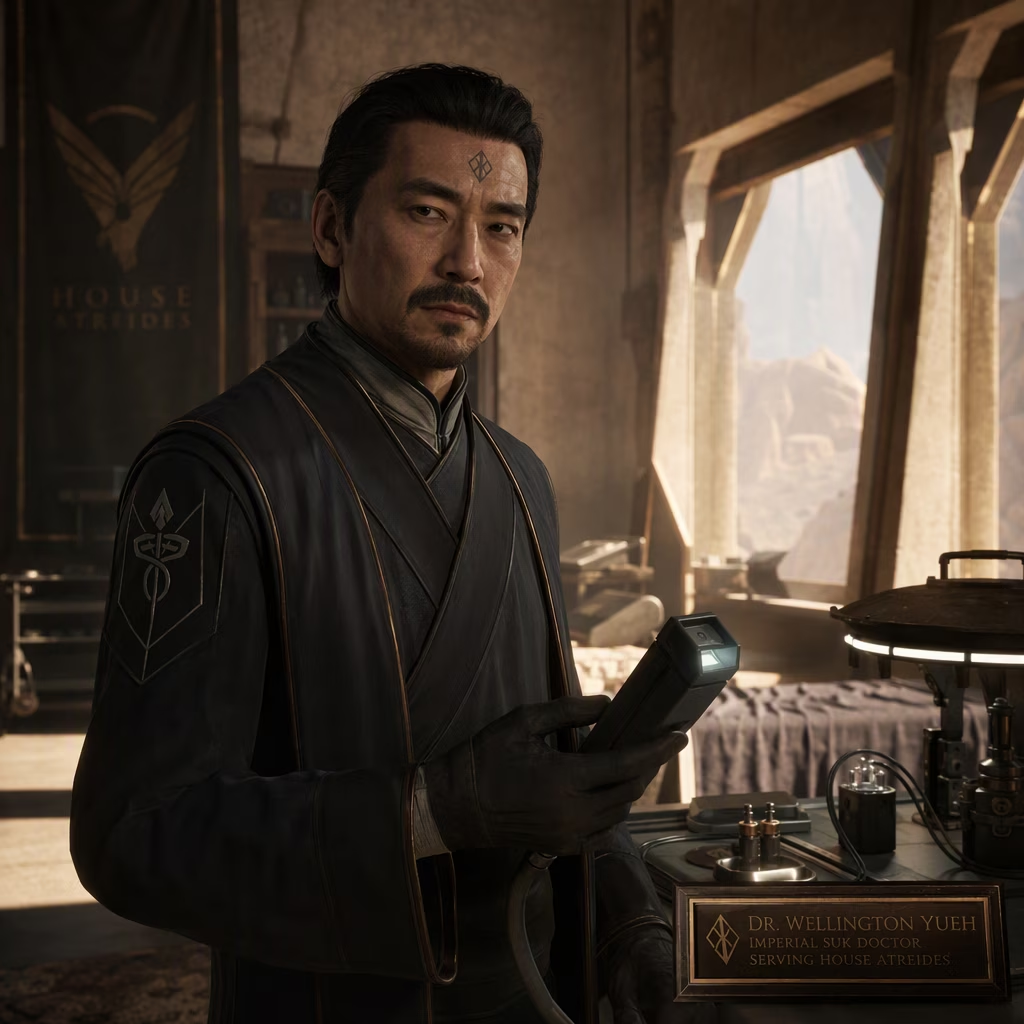
The official description places Dune Awakening on Arrakis and says it takes inspiration from both Frank Herbert's novels and Denis Villeneuve's Academy Award-winning film while exploring exciting new possibilities in the franchise. That combination matters. The novels provide the deep lore, the ecological tension, and the social complexity. The film provides a visual language of heat, scale, and brutalist science fiction. A game that can borrow from both has room to be more than a simple adaptation. It can be a survival sandbox where the desert itself is the main antagonist.
Funcom is the studio behind Conan Exiles, and that comparison is unavoidable. Conan Exiles earned a reputation as a slow, arduous survival game that still held allure after dozens of hours. Players who stuck with it often talked about the pull of returning to the Exiled Lands, even when the experience was punishing. That track record suggests Funcom understands long-term survival systems: resource gathering, crafting, base building, and the strange social life that emerges when players share a hostile map. Dune Awakening does not need to be Conan Exiles in sand, but the studio's experience with persistent worlds is clearly part of the pitch.
| Feature | What the reveal suggests |
|---|---|
| Setting | Arrakis, the desert planet of Dune |
| Genre | Open-world survival MMO |
| Platforms | PC, PlayStation 5, Xbox Series X |
| Inspirations | Frank Herbert's novels and Denis Villeneuve's film |
| Teaser highlights | Spice harvesters, giant sandworms, worm riding |
The phrase open-world survival MMO carries clear expectations in 2026. Players expect to gather materials, manage resources, build shelters, and face threats that do not pause for a story beat. On Arrakis, those systems have a natural vocabulary. Water discipline becomes a survival mechanic. Spice becomes a reason to venture into dangerous territory. Shelter becomes a defense against heat, sandstorms, and things that move beneath the dunes. Worm sign becomes the equivalent of a horror game's distant footsteps. The teaser did not explain these systems, but it did not need to. It showed the scale, and scale is exactly what a survival MMO needs.
The sandworm riding image is especially important. In Dune, riding a sandworm is not a casual mount unlock. It is a ritual, a display of control, and a reminder that humans survive on Arrakis by respecting its rules. If Funcom can turn that idea into a gameplay loop, Dune Awakening could separate itself from other survival games. The fantasy is not simply conquering the desert. It is learning how to move with it.
Funcom has also been active in building the team. The studio has invited developers to help shape a world made boundless by its deep lore and enduring themes, asking them to join the effort to build a Dune for all fans to realize the dream of traversing its ever-shifting landscape, sand under fingernails and spice in the air. That language is marketing, but it also points to the kind of production Funcom is attempting. The project is not being framed as a quick tie-in. It is being framed as a world with its own weather, economy, and social pressure.
For players in 2026, the appeal is easy to understand. Dune is a franchise about scarcity, power, and adaptation. An open-world survival MMO is a genre about scarcity, power, and adaptation. When those two ideas meet, the result does not need to be a power fantasy. It can be a game about reading the land, choosing allies, and knowing when to run. Funcom has not revealed every detail, and that is fine. The teaser already did its job: it made Arrakis feel enormous, dangerous, and worth exploring. 😎
According to coverage from Game Developer, one of the most important questions for a large-scale survival MMO is how its core systems reinforce the fantasy of the setting rather than merely decorate it. In the case of Dune Awakening, that perspective fits especially well, because mechanics like water scarcity, environmental threat, traversal risk, and faction-driven conflict all need to feel meaningfully tied to Arrakis instead of functioning as generic open-world tasks layered onto a famous license.