
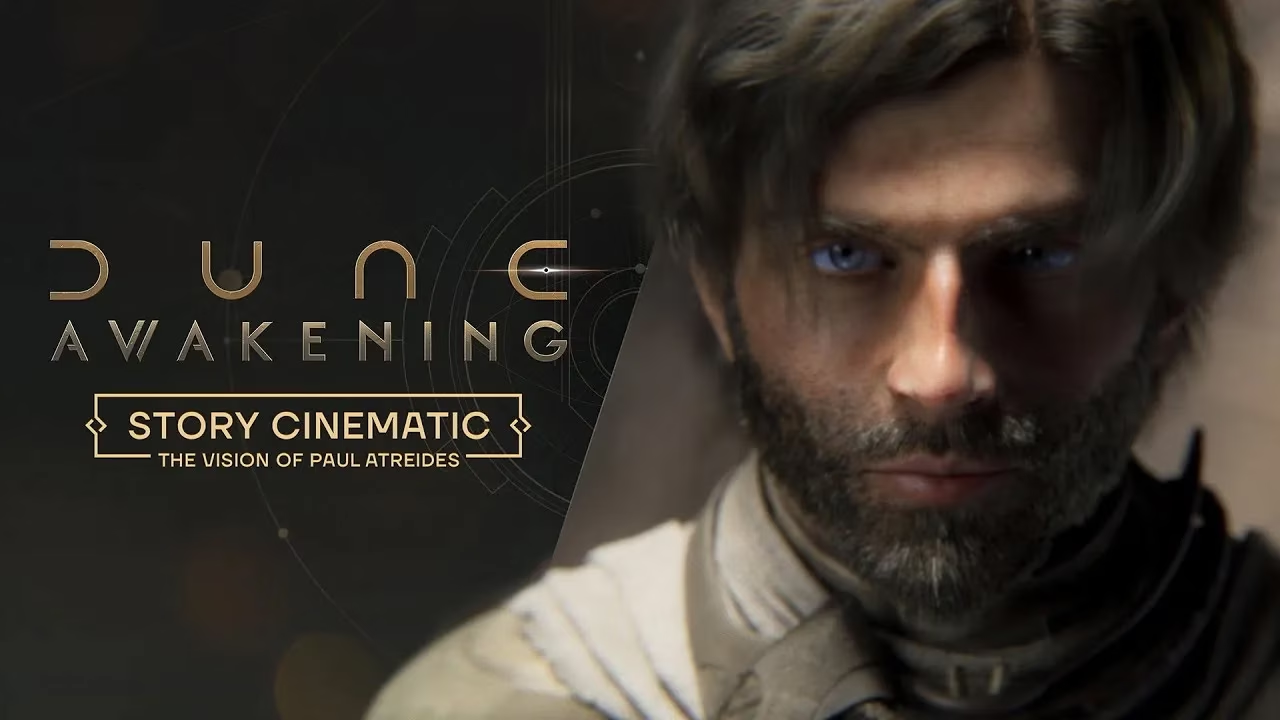
Dune: Awakening approaches Arrakis from a deceptively simple question: what if Paul Atreides had never been born? The story cinematic, The Vision of Paul Atreides, frames that question through Paul himself—or rather, through a version of Paul who exists only as a witness to a timeline he never inhabited. He speaks about a world shaped by his absence, and that world is where Funcom's survival MMO unfolds. It is an alternate-history Dune, a 'what if' scenario built with the Herbert family and Legendary Pictures, and its starting point is one of the most consequential changes possible in the saga.
🌒 The single pebble that starts a landslide
In canonical Dune, Lady Jessica is meant to bear a daughter to Duke Leto Atreides. Instead, she chooses to give him a son and heir: Paul. That decision infuriates the Bene Gesserit and sets off a chain of events that reshapes the known universe. Dune: Awakening asks what happens if Jessica obeys. In this version of the story, she gives birth to a girl, and Paul is never born.
Joel Bylos, creative director at Funcom, described the premise as finding 'a single point, the single pebble that starts a landslide.' That image is apt. The change is small on its surface—one child, one gender, one obeyed order—but it ripples outward across politics, prophecy, family, and war. The game does not simply remove Paul from the story. It rebuilds the board around his absence.
⚔️ A different Arrakis
The consequences are sweeping, and they make Dune: Awakening feel like a familiar desert planet viewed through a cracked lens. Duke Leto is still alive. His assassination has seemingly been foiled by Paul's alt-history sister, a figure who may be more capable at sniffing out treachery than Paul ever was. House Atreides survives the Harkonnen attack, which sounds like a victory for the family. Yet the larger picture is far from stable.
| Timeline element | Canonical Dune | Dune: Awakening's alternate history |
|---|---|---|
| Paul Atreides | Born to Lady Jessica and Duke Leto | Never born |
| Lady Jessica | Defies the order to bear a daughter | Obeys and gives birth to a girl |
| Duke Leto | Assassinated during the Harkonnen attack | Survives; assassination is apparently foiled |
| House Atreides | Falls after the Harkonnen assault | Survives the attack |
| The Fremen | A hidden power on Arrakis | Supposedly 'exterminated' somehow |
| The Sardaukar | Used in the Harkonnen plot | Summoned to Arrakis to stop Leto from fully controlling the spice trade |
That table makes the scale of the shift clear. House Atreides is stronger, or at least less broken, but the Fremen are reportedly gone. The Sardaukar have been drawn into the desert in force. The spice trade remains the prize, and the balance of power is tense rather than settled. Arrakis is still a pressure cooker, but the valves have been rearranged.
🪐 Why the premise matters for a survival MMO
For a survival MMO, this is more than a lore twist. Arrakis is already a world of scarcity, danger, and competing factions; an alternate timeline gives Funcom room to rearrange those pressures without abandoning the identity of Dune. Players enter a version of the planet where House Atreides has not been shattered in the usual way, where the Harkonnen attack failed to produce the expected outcome, and where the Fremen's fate is shrouded in grim rumor. The result is a political landscape that feels recognizably Dune-like but freshly unstable.
It also gives the game a strong narrative hook. Survival games often ask players to master an environment, but Dune: Awakening can ask them to master a history that should not exist. The desert is the same. The stakes are not. Every faction, every settlement, and every spice field carries the shadow of a missing person who might have changed everything.
🌌 A ghost at the center
Paul's presence in the cinematic is deliberately paradoxical. He is there, but he is not. He ruminates on a timeline where he never existed, giving the story a ghostly center. The franchise has always been interested in prescience, fate, and the terrible weight of choosing a path. Dune: Awakening twists that interest into a meta-question: what does a chosen one mean when the chosen one was never born? The answer appears to be a world that is freer in some ways and more fragile in others.
As of 2026, the game's central 'what if' remains the clearest lens through which to understand its world. The original reveal pointed to closed beta tests before the end of 2024, a sign that Funcom intended to test both the desert survival loop and the altered timeline with players. At the time, even Paul Atreides could not see a release date in his visions of the future. The more enduring point is that the alternate history is not a side note or a marketing gimmick. It is the foundation.
🧭 Final thoughts
Dune: Awakening uses one of science fiction's most famous family trees as a starting point and then prunes it at the root. Lady Jessica's obedience, Paul's absence, Leto's survival, and the Fremen's apparent destruction form a chain of consequences that could support an entire saga. For players, that means an Arrakis that is both instantly recognizable and deeply wrong. The spice still flows. The worms still rise. The politics still cut. But the future has been rewritten, and the ghost of Paul Atreides lingers over every dune.