
Surviving the endless deserts of Arrakis requires more than just guts — it demands a fortress you can truly call home. In 2026, Dune: Awakening continues to evolve, but the core principles of constructing a resilient base remain the bedrock of every player's journey. Whether you're a fresh exile or a veteran sandwalker, mastering the fundamentals of base building will mean the difference between thriving and being devoured by the planet's ruthless environment. Let's dive into how to place your first structures, keep the lights on, and streamline production using the game's clever Circuit system.
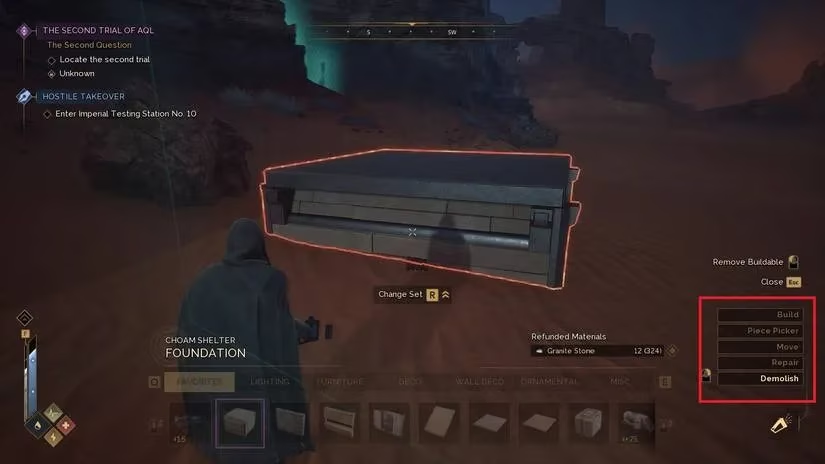
The very first action you take when building is arguably the most critical. Before even thinking about walls or workbenches, pull out your Construction Tool and drop the Sub-Fief Console. This unassuming device acts as your land claim block, defining the exact boundaries within which you can build. Once planted, the buildable area is locked to that initial location — but don't worry, the console itself can be moved around freely afterwards to serve as your base's command center. Skipping this step is impossible, and placing it wisely will save you frustration later.
🛠️ Construction Tool 101: Piece Mode vs. Blueprint Mode
Your Construction Tool is the swiss army knife of base building. Equipping it gives you immediate access to a radial menu that toggles between three distinct modes by pressing the right mouse button or R3 on a controller:
-
Piece Mode – Directly places structural components like walls, floors, ceilings, and foundations. Ideal for quick assembly.
-
Blueprint Mode – Drops a translucent 3D preview of the piece without consuming resources. Perfect for planning complex layouts before committing materials.
-
Piece Picker (
RMB/R3cycle) – Snaps to an existing placed piece and copies its type, letting you rapidly extend walls or add identical elements without menus.
Most new players overlook the Blueprint functionality, but it's a godsend when you're working with a group. Your allies can see where you intend to place items and can even contribute resources to complete those ghostly outlines. This collaborative building filter is one of the many subtle quality-of-life touches added since launch, making clan projects far smoother in 2026.
🏭 Placing Crafting Stations and Furniture Like a Pro
Once you understand the tool, the real fun begins. To access crafting stations — like Fabricators, Refineries, Storage units, or even decorative cacti — hit the Change Set button displayed in the center of your screen while the Construction Tool is active. This opens a sub-menu that categorizes every buildable object in the game.
Here's a quick breakdown of major categories you'll interact with constantly:
| Category | Function | Examples |
|---|---|---|
| Structures | Core building blocks | Walls, stairs, roof tiles |
| Crafting | Production & refinement | Fabricator, Smelter, Assembler |
| Storage | Item containment | Small Chest, Supply Crate |
| Decoration | Aesthetic & ambiance | Rugs, lighting, trophies |
| Utilities | Essential systems | Sub-Fief Console, Reprojectors |
Selecting any item will snap you back to placement mode, where you can use the same piece/blueprint logic. A pro tip from 2026's community: always leave a small "core room" near your console where you cluster your most-used Fabricators. That ensures quick access when you need to repair gear or craft emergency supplies during a sandstorm.
⚡ Powering Your Base and Avoiding Blackouts
Everything good in your base runs on electricity. Early on, you'll rely on the Fuel-Powered Power Generator, a clunky but reliable machine that converts Fuel Cells directly into energy. Each generator pumps out a maximum of 75 units of power, and every crafting station you deploy will reserve a portion of that capacity just by existing.
Here's where the challenge lies: over-expansion. If you plop down too many hungry Fabricators and Refineries, your total power demand will exceed supply, and your entire grid will crash. No power means:
-
Your base shield collapses, exposing buildings to corrosive winds and sandworm tremors.
-
All production halts, leaving you stranded mid-craft.
-
Automated defenses (if you have them) shut down, inviting opportunistic raiders.
To recover, either spin up additional generators or temporarily dismantle non-essential crafting benches. Smart builders in 2026 often dedicate a separate power wing with multiple generators and a clear visual indicator (like a red blinking lamp circuit) to warn them when reserves are low. As you progress, you'll unlock solar arrays and even geothermal taps that provide cleaner, stronger alternatives — but the balancing act remains the heartbeat of base management.
📦 Relocating and Saving Your Masterpiece with Blueprints
One of the most underappreciated features is the ability to save and move entire bases without starting from scratch. Using the Solido Replicator, craftable at any Fabricator, you can store a complete blueprint of your current base layout and deploy it elsewhere. This is a game-changer when you find a richer resource patch or simply want a better view.
However, the Solido Replicator comes with two crucial caveats:
-
It does not rebuild your base for you. The blueprint only shows where every piece goes; you must manually place the required materials into each ghost structure.
-
Crafting stations and storage containers included in the blueprint will be carried over, but any items stored inside them at the time of copying are not saved. You'll need to pack up your inventory separately.
Because of this, many clans designate a "moving day" where multiple members pitch in resources simultaneously. The resulting synergy slashes rebuild time drastically. If you're solo, though, consider packing only the essential sections and leaving behind what you can easily reconstruct.
🔒 Permission Settings: Your Invisible Wall Against Chaos
Whether you're part of a massive spice cartel or a tight band of three, you'll want to dial in your base permissions immediately. By interacting with the Sub-Fief Console and navigating to the Permissions tab, you can assign custom access levels to specific players or entire clans.
Permission levels range from Owner (full control) down to Visitor (can enter but not interact). The granularity is impressive — you can:
-
Allow trusted friends to open doors and use crafting stations but forbid them from removing stored items.
-
Make certain chests public for clan members but keep your rarest gear behind an additional permission lock.
-
Prevent anyone from accidentally dismantling important structural pieces.
Individual furniture, crafting benches, and doors also have their own General Settings menu where you can override default permissions. This dual-layer system means you could, for example, let newcomers roam freely in your common area but lock your personal quarters with a separate key entirely. In 2026, after several major PvP-focused updates, these settings are more vital than ever — a misconfigured door has been the downfall of many a base.
🔗 Circuit Systems: The Industrial Backbone of Your Base
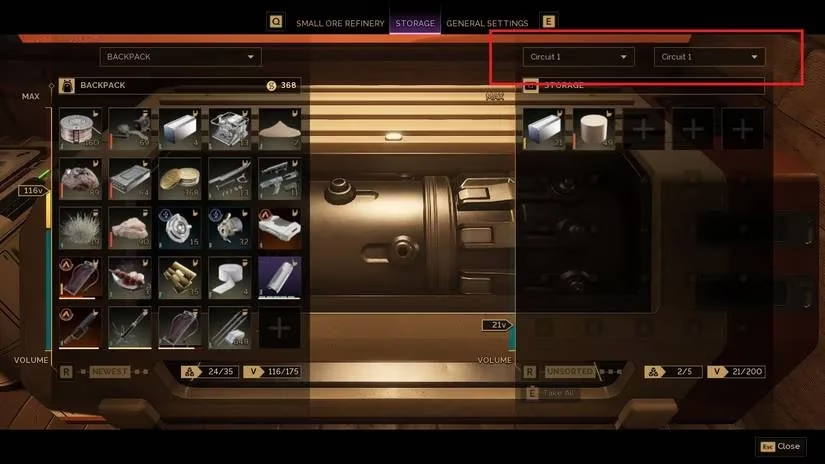
Perhaps the most elegant innovation in Dune: Awakening is the Circuit system, which transforms your base from a collection of machines into an automated, intelligent workshop. The concept is simple: crafting stations can automatically pull materials from storage containers that share the same Circuit, eliminating the need to keep everything in your personal inventory.
Imagine this setup:
-
Circuit 1 (Iron Processing) – Assigned to a Smelter that consumes Iron Ore and a Fabricator that produces Iron Plate. The Input Circuit connects to Storage A, which exclusively holds Iron Ore, while the Output Circuit directs finished plates into Storage B.
-
Circuit 2 (General Manufacturing) – Fed by containers holding plastics, copper, and composites, powering an Assembler that builds advanced components on demand.
-
Circuit 3 (Personal Gear) – Sips from a secure container only you can access, enabling discreet crafting of high-value weapons.
To configure this, simply approach any crafting station, open its Manage tab, and assign the desired Input and Output Circuits. The UI has been refined over the years — in 2026, you can even color-code circuits for at-a-glance monitoring. Players who master this system report spending 40% less time running between chests and 90% more time harvesting spice.
A final piece of wisdom: always label your storage rooms with signs or colored lights. When a sandstorm hits and your power is flickering, the last thing you want is to guess which circuit your repair kits are tied to. With a well-organized base, the unrelenting brutality of Arrakis becomes just a little more survivable. And in this world, every advantage counts.