
As a new player stepping onto the sands of Arrakis in 2026, one of my first and most pressing questions was about the consequences of failure. How does death work in Dune: Awakening? In many survival MMOs, death can mean losing hours of hard-earned progress, a punishing system that can deter newcomers. Having navigated the deserts now, I can share that the game's approach is nuanced, designed to balance tension with fairness, though certain threats remain utterly unforgiving.
Let's start with the most common scenario: a normal death. Contrary to what you might expect, your journey doesn't end immediately when your health hits zero. Whether you're shot by a Harkonnen patrol, stabbed by a Fremkin ambusher, or succumb to the relentless Arrakeen sun, you are first knocked into a downed state. This is your critical window for survival. In this state, you have a chance to self-revive or be revived by an ally by holding the interact button (X/Square/F on your controller). A revival bar begins to fill, but you must complete it before a separate, depleting gold bar reaches zero. Be warned: any further damage from enemies will reduce your chances, causing that gold bar to drop faster. Success means getting back on your feet with a sliver of health restored, ready to fight or flee.
If you fail to revive, your character dies. Here's where the penalty applies, but it's far from a total loss. You can respawn at various points:
-
Your personal base.
-
Crafted and placed Respawn Beacons.
-
Checkpoints in certain quest locations.
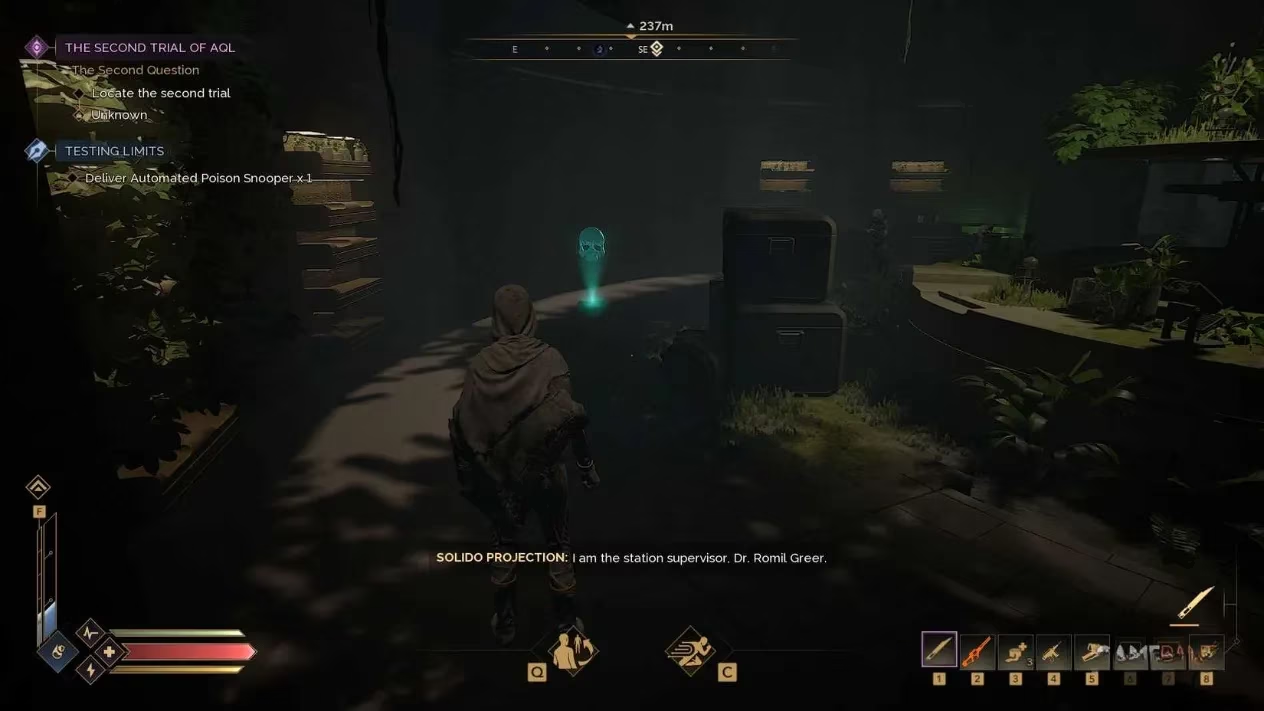
The good news? You retain all your equipped gear—your armor, your favorite crysknife, your harvesting tools—and you lose no experience or skills. This means you're not defenseless when you rush back into the world. The temporary loss is the contents of your backpack: gathered resources, currency (Solari), ammunition, and spare tools. However, this dropped backpack is clearly marked on your map and compass with a skull icon. You simply need to return to the location to reclaim everything. Even your gear's durability only suffers minor damage, easily repaired at a workbench. Crucially, quest items remain safely in your inventory. So, a normal death from NPCs or environmental hazards is a minor setback, not a catastrophe, as long as you can safely retrieve your pack. Furthermore, in PvE areas, other players cannot loot your dropped backpack; it's yours alone to recover.
However, Arrakis is not a forgiving planet. While normal deaths are manageable, two existential threats promise total, irrevocable loss. The first is the legendary Sandworm. If you fail the rhythmic survival minigame and are consumed by Shai-Hulud while traversing the open sands, the penalty is absolute:
-
All equipped gear is lost.
-
Everything in your backpack is lost.
-
Any vehicle you were riding is destroyed.
Nothing is retrievable. This makes worm encounters the ultimate test of awareness and skill. Learning their signs and the proper thumper techniques is not optional; it's essential for survival.
The second scenario for total loss is confined to the end-game Deep Desert, a lawless PvP zone. Here, the rules change dramatically. Once a week, a cataclysmic Coriolis Storm sweeps across the region, wiping out all player structures and resetting the landscape. If your character is caught in one, it's a complete loss. (Note: normal desert storms elsewhere only cause the standard, recoverable death). The Deep Desert is also the primary arena for player-versus-player conflict.

For most of your playthrough, you don't need to worry about PvP. It's strictly limited to the Deep Desert and a few other marked locations that provide clear warnings. However, if you are killed by another player in these zones, the stakes are higher. The victor can loot the resources, Solari, and Spice from your backpack. Therefore, smart preparation is key before venturing into PvP territory:
-
Deposit your Solari in a bank.
-
Store valuable resources in your base's stash.
-
Travel light with only what you need for the expedition.
Normally, even in PvP, your equipped weapons and armor are safe and will remain with you upon respawning. There is one terrifying exception: if a Landsraad decree is active for the week, it can enable full PvP looting in the Deep Desert, meaning even your equipped gear could be stolen. Always check the political status of the desert before heading out!
To summarize the death mechanics of Dune: Awakening:
| Death Type | Location | Penalty for Backpack | Penalty for Equipped Gear | Recoverable? |
|---|---|---|---|---|
| Normal (PvE) | Most of Arrakis | Dropped, marked on map | Retained, minor damage | ✅ Yes, if retrieved |
| Sandworm | Open Desert | Everything lost | Everything lost | ❌ No |
| PvP Kill | Deep Desert/PvP Zones | Resources/Solari/Spice looted by killer | Retained (usually) | Partially |
| Coriolis Storm | Deep Desert | Everything lost | Everything lost | ❌ No |
| Landsraad Decree (Full Loot) | Deep Desert | Everything looted | Everything lootable | ❌ No |
My advice after months on Arrakis? Don't fear death in the early and mid-game. The system is designed to keep you moving forward. Respect the sand, master the rhythm of survival against the worms, and be shrewd about when and where you engage in high-stakes PvP. Manage your risks, and you'll not only survive but thrive in the endless dunes. The spice must flow, after all. :desert: